

 One of my biggest thrills is if I find a whole collection of linens from one family, piles of napkins, towels and sheets neatly bundled together in packets tied with faded ribbons. Carefully labeled, many never used, for whatever reason.

 This trip, I hit the jack pot! A dealer let me know that she bought "the entire linen closet" from an old stately petit chateau {castle} once belonging to three never-married sisters of noble birth.
Was I interested in seeing some of them?
This trip, I hit the jack pot! A dealer let me know that she bought "the entire linen closet" from an old stately petit chateau {castle} once belonging to three never-married sisters of noble birth.
Was I interested in seeing some of them?
 The linens were made for each of the young ladies in 1900-1908, when they became of marriageable age. The best families {and theirs certainly was!} had their own live-in seamstress who created the trousseau with incredible skill and patience. Each napkin, each towel, each tablecloth and linen nightdress was embroidered by hand with the initials of the bride-to-be to use when she got married.
For these three ladies, that day never came.
Whether they suffered from a loss of eligible men because their beaus died in the Great War, or they were just too finicky to find a suitable husband, we'll never know.
The linens were made for each of the young ladies in 1900-1908, when they became of marriageable age. The best families {and theirs certainly was!} had their own live-in seamstress who created the trousseau with incredible skill and patience. Each napkin, each towel, each tablecloth and linen nightdress was embroidered by hand with the initials of the bride-to-be to use when she got married.
For these three ladies, that day never came.
Whether they suffered from a loss of eligible men because their beaus died in the Great War, or they were just too finicky to find a suitable husband, we'll never know.
 They lived together until their late 90's, then a great-great nephew inherited their land, their stately petit chateau, and everything else when the last of the sisters passed away. Sadly, he decided to sell the whole thing, contents and all, last year, he didn't want it.
I know, it's sad and painful, isn't it?
They lived together until their late 90's, then a great-great nephew inherited their land, their stately petit chateau, and everything else when the last of the sisters passed away. Sadly, he decided to sell the whole thing, contents and all, last year, he didn't want it.
I know, it's sad and painful, isn't it?
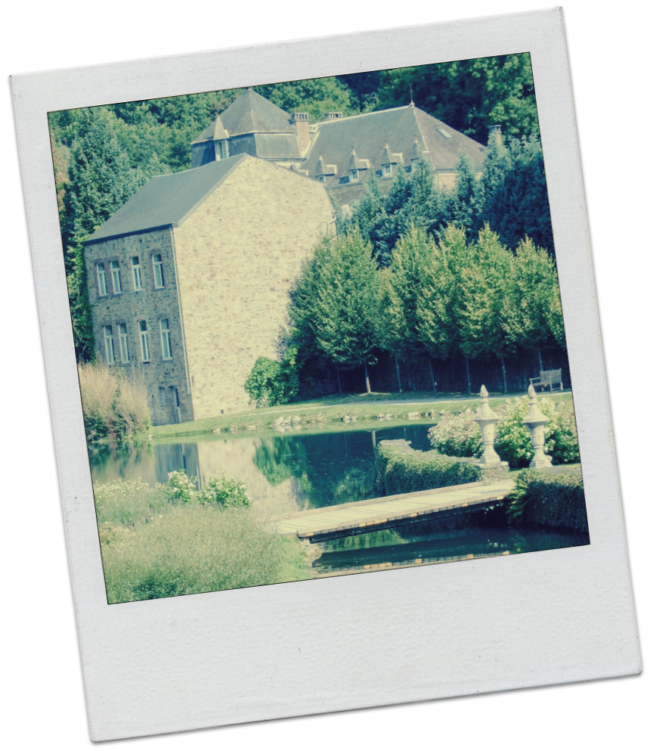 I tried my best to wrangle the name of this noble family from the lips of the dealer, but in Europe, they do their best to protect the "honor" of the old families.
Even when you buy things at auction, the auctioneer will list something as belonging to "Madame X" or "Monsieur G". So the photos above are not of their actual home, I just chose a photo that was the kind of home they would have lived in. {there are many of those all over Europe - we stayed in one converted to a Hotel you read about here >}
I tried my best to wrangle the name of this noble family from the lips of the dealer, but in Europe, they do their best to protect the "honor" of the old families.
Even when you buy things at auction, the auctioneer will list something as belonging to "Madame X" or "Monsieur G". So the photos above are not of their actual home, I just chose a photo that was the kind of home they would have lived in. {there are many of those all over Europe - we stayed in one converted to a Hotel you read about here >}
 So that is the story of my recent purchase of the most beautiful linens.
 The tea towels, never used, so carefully hemmed and monogrammed, over a century old and never used, not once.
Each little stack labeled with the year they were made. These exclusif blue and yellow tea towels, with the most amazing quality linen and design, for instance, were made in 1900.
The tea towels, never used, so carefully hemmed and monogrammed, over a century old and never used, not once.
Each little stack labeled with the year they were made. These exclusif blue and yellow tea towels, with the most amazing quality linen and design, for instance, were made in 1900.
 I bought the most unusual ones I could afford, in the blue and golden yellow colors. Their damask patterns are beyond stunning! And bought an extra suitcase to take them home with me on the plane, since I didn't want us to have to wait for the other shipments to come in later in November.
 I bought mostly towels of the "exlusif grande luxe" class, {there are apparently two different "classes" of tea towels, the exclusif grand luxe and the more plain every day ones. I used to think that the more country style plainer towels came from less monied homes, but the dealer educated me and said, non, they are from the same home. The exclusif are for use with the family's finest crystals and porcelains.

 I'm not sure exactly how cook and the kitchen maids were to decide which class of towel to use, but I'm pretty sure they dried the dishes for the family with the luxury cloths and used the others for drying their own dishes.

 There is definitely a difference in the two kinds of towels, the designs and "hand" of the luxury cloths are of a finer quality. Their lesser thought of country cousins are to my eye just as lovely, but I can see that they are less intricate in pattern and design.
 The tablecloths are in one word...amazing! Tiny precise embroidery designs on printing white or cream heavy linen cloth, so beautiful I almost cried when the dealer unpacked them.
 Many were made in France, but some, like the Cantu Lace Runners below, were bought from Italy for the trousseau of the brides.
 The linens I bought are between 100 and 150 years old and made of homespun linen, or metis {linen and cotton} with hand embroidered monograms and/or designs and meticulously hand stitched hems.
 Before I go, I want to share this towel with you. At first I wasn't going to buy these, because they cost the earth. Apparently all white or cream woven towels with figures in them are exceptionally rare.
Of course, once I'd looked at that face a few times, I fell for her. Who wouldn't?
Before I go, I want to share this towel with you. At first I wasn't going to buy these, because they cost the earth. Apparently all white or cream woven towels with figures in them are exceptionally rare.
Of course, once I'd looked at that face a few times, I fell for her. Who wouldn't?
 The woven in patterns are so exquisite, it really is a lost art. No one does this anymore.
 No matter how beautiful they are, I love to use my antique tablecloths for my special dinners. The napkins look perfection on a plate and the cloths just fall perfectly. These linens were meant to be used, and enjoyed. If you have or buy antique linens like this, I hope that you use them every day, or once in a while at least, to relish in their quality and beauty!
Their fabric is no longer being produced, they are beautiful remnants of a time past. Savor them as the treasures they are, maybe you will pass along a love for old textiles to your children, grandchildren, or perhaps a niece, as heirloom treasures that they may someday use in their own households.
No matter how beautiful they are, I love to use my antique tablecloths for my special dinners. The napkins look perfection on a plate and the cloths just fall perfectly. These linens were meant to be used, and enjoyed. If you have or buy antique linens like this, I hope that you use them every day, or once in a while at least, to relish in their quality and beauty!
Their fabric is no longer being produced, they are beautiful remnants of a time past. Savor them as the treasures they are, maybe you will pass along a love for old textiles to your children, grandchildren, or perhaps a niece, as heirloom treasures that they may someday use in their own households.
 The old houses in Europe are still being emptied out, and the contents sold off, but the supply of linens of this quality and history is not endless, it is coming to an end. Sooner rather than later the supply will run out, so if you get the chance to add even just one exceptional linen like these to your collection, do it!
DO YOU USE YOUR ANTIQUE LINENS OR JUST DISPLAY THEM IN YOUR LINEN CUPBOARD?
SHOP FRENCH ANTIQUES
The old houses in Europe are still being emptied out, and the contents sold off, but the supply of linens of this quality and history is not endless, it is coming to an end. Sooner rather than later the supply will run out, so if you get the chance to add even just one exceptional linen like these to your collection, do it!
DO YOU USE YOUR ANTIQUE LINENS OR JUST DISPLAY THEM IN YOUR LINEN CUPBOARD?
SHOP FRENCH ANTIQUES
à bientôt
 If you want to romance your Home and Garden with antique and vintage treasures to make you smile each time you come home, visit our shop FrenchGardenHouse.
39 comments
Vicki, I’m so sorry, but I don’t offer antique pattern identification nor valuation. I think if you search on the internet, you may find a service that will do this for a small fee for you.
I wonder if you could help me identify the age, origin,…of this French linen tablecloth. It is 15’ x 6’, it’s an intricate lace pattern incorporating 12 French castles, and the initials ACS or SCA- I’m not sure the order because they are imposed over each other. I am sure it’s at least 75 years old.
I can send a picture but not sure how to do so.
Candi,
Thank you so much for visiting, and taking the time to leave a comment. I hope you use your beautiful collected linens, too!
Oh Lidy! Just wow! I’ve always loved linens and admired the work and talent that someone put into each piece. You give us so much history and background. I’m going to look at my collection with new admiration, and dream of adding to it.
Thanks so much for your visit today Mary Ann! I love having you visit, and sharing our love for antiques
together.
Breathtaking beautiful! What a treasure. Thank you for sharing,
Lynda, thank you so much for your visit and taking the time to leave a comment. I hope you will join us here on a regular basis. Welcome!
Nancy, the ordinary linens were probably beautiful, and your mom used the damask for Sundays or holidays, those tablecloths were so beautifully made back then!
I certainly did not come from a grand family so we just had ordinary linens but my mother did have some damask tablecloths.Not the quality of these but they were nice all the same. So lovely to see these ones from France.
These are just lovely. Enjoying your blog very much.