


Handkerchiefs have always carried with them
love, hope, heartache and joy.

Many of us have a lingering fondness for a handkerchief
that once belonged to our grandmother or mom.

Little squares of cotton or silk that we treasure.
Generations of women have held a handkerchief for the important moments in their lives
and wiped away tears at weddings, funerals, and really funny or sad movies.

Some handkerchiefs have been saved for decades, even centuries.
I personally cherish handkerchiefs left to me by my grandmother and Mom
keepsakes that are so special to me.

Handkerchiefs come in all forms and sizes.
From the elegant, work-of-art made of finest linen edged with glorious hand made lace
to a simple printed square of cotton.

Being from Europe, I've never really gotten used to kleenex.
Give me a folded beautiful handkerchief any day!
{I know, but really, it's eco-sound! And there is the washing machine!}
The origin of handkerchiefs is not glamorous, the name “handkerchief” comes from medieval head scarves called “kerchiefs”,
a cloth that was originally used to wipe away perspiration from one's head.

HISTORY
The history of handkerchiefs is long, and {believe it or not!} hotly debated by scholars.
In 2,000 B.C. wealthy Egyptians carried the first handkerchiefs made of bleached white linen.
The Kunsthistorisches Museum in Vienna, Austria has a limestone plaque of two sisters, Keti and Senet, holding their handkerchiefs.

Some historians believe handkerchiefs originated in China,
and used to shield a person’s head from the hot sun.
Statues dating to the Chou dynasty {1000 BC} show figures holding decorative pieces of cloth.

Wealthy Roman citizens waved expensive linen handkerchiefs in the air at public games,
and after they wiped the perspiration off their faces,
they threw them in the arena at the beginning of gladiatorial contests.
During the middle ages, knight's tied a lady’s handkerchief to the back of their helmet
as a good luck talisman.

Renaissance portraits show both men and women holding handkerchiefs embroidered
and edged in lace, the more ornate the better.
It’s not surprising the handkerchief became an accessory for flirtations and illicit liaisons in France.

Made of silk or finest batiste, and edged with hand made laces that cost a fortune,
it was another way for aristocrats to distinguish themselves from peasants.
Considered valuable enough to be listed in dowries, and bequeathed in wills.

Aristocrats sitting for portraits would request that a handkerchief be included in the picture,
the more embellished the better, to indicate their status and position.

Considered a symbol of wealth, handkerchiefs became larger and larger,
until, in 1785 Louis XVI issued a decree prohibiting anyone from carrying a handkerchief larger than his.
Held in the hand, they were necessary for "the flirt"
Handkerchiefs also demonstrated wealth and social status.
Peeking out from little bags, tucked into sleeves, or draped across an arm,
the lace and embroidered luxuries were meant to be admired.
Royalty owned dozens of handkerchiefs edged in Flanders needle lace, or wildly expensive Venetian laces.

Jumping to the Great Depression, handkerchiefs became "the" accessory for women to change their look,
it was all they could afford. During WWII, women opted for a wardrobe of hankies,
foregoing new hats or blouses for the war effort.

Vogue magazine had an ad featuring a "handkerchief" of the month, a brightly colored printed cotton one.

After the French couture houses got back into full swing after WWII,
designers like Dior and Balmain featured handkerchiefs as the best accessory of the season.
Tied to handbags, popping out of a jacket or blouse pocket, worn as a bracelet on the wrist,
handkerchiefs were back in a big way.

In the 1950's-1960's, handkerchiefs flourished.
Big stores like Neiman Marcus and Lord & Taylor hired commercial artists to design
bright, colorful handkerchiefs for their stores.
Hundreds of designs were produced each year.

Eventually, most people switched over to the disposable Kleenex,
but handkerchiefs are coming back!
With our "green" mindset, many people are once again reaching for that little square of fabric.
Hermes sells beautiful limited edition silk handkerchiefs that are bought by women as well as men.

"The tradition of borrowing a bridal hankie may have stemmed from the times
when they were too expensive for a young bride to afford."
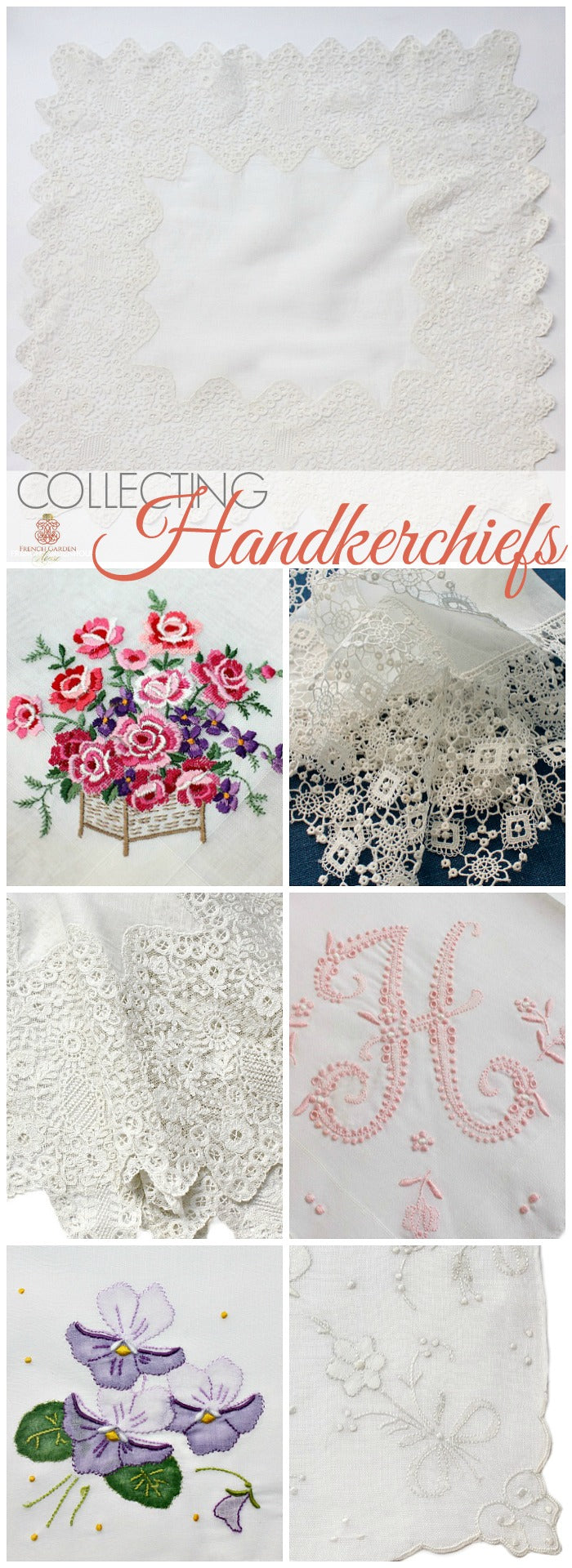
WHAT TO COLLECT: CONDITION. As with everything, buy the best quality you can find and afford. Look for fine linen, hand rolled hems, or beautifully scalloped hems, and avoid badly stained or damaged handkerchiefs. TYPE. Some collectors only collect the most rare, antique hand embroidered and hand made lace handkerchiefs from the 19th century, or very early 20th century. These sumptuous hand made confections recall the past, when no lady of means would ever be without her luxurious delicate handkerchiefs. Some collectors only collect the vibrant cotton batiste handkerchiefs from the 1930's-1940's. Often printed with themes, such as flowers or states, these are bright, whimsical and fun! Round handkerchiefs of this sort are more rare to find, as they didn't quite catch on, so they were made for a very limited time. Handkerchiefs made on linen in Madeira is yet another favored type of handkerchiefs collectors value greatly. Embroidered by hand by the skilled needlewomen of the island of Madeira, they are in a class of quality of their own! THEME. Some collectors favor particular themes, like circus animals, signed-by-the-artist handkerchiefs, or advertising. Some seek out geometric prints, florals, or monogrammed handkerchiefs. WHAT TO PAY. Handkerchiefs, big or small, simple or sumptuous, can command from a few to more than a thousand dollars for a particularly extensively embroidered luxurious example. There is a handkerchief for every collector's budget. Here at FrenchGardenHouse I am most often enchanted by the hand made, luxury pieces of the past from the mid to late 1800's, although the cheerful bright floral hankies from the 1940's-1960's also capture my eye and heart.
Are you a collector and/or user of antique and vintage handkerchiefs?
 If you want to romance your Home and Garden with antique and vintage treasures to make you smile each time you come home, visit our shop FrenchGardenHouse.
39 comments
I especially love the white embroidered ones. I recently started to collect one for each of my four granddaughters for when they get married, as my mother did for me. I’m on the hunt for that just perfect one with each of their initials.=)
Theresa, such a blessing to have your grandmother’s and mother’s handkerchiefs. There are so many beautiful ideas for display, if you don’t sew, I’ve seen gorgeous handkerchiefs framed, either singles, each in their own frame and hung in a grid or line, or a bunch of them together folded in overlapping triangles in a large frame. It looks like art, and is a great way to keep the handkerchiefs clean too!
Lorrie, what a beautiful and inspiring idea~ I can’t imagine a sweeter gift for a new baby. I absolutely love it!
Edie Marie, how wonderful!! So many memories you have in handkerchiefs. I love the idea of the quilts, what beauties they will be when you finish them, that’s such a fantastic idea. Wishing you a beautiful week, Edie Marie. xo
Lidy,
Thank you for such an informative and interesting article. I use monogrammed hankies to make plaques that spell out a baby’s name to give as gifts to new moms.
Lidy your collection is beautiful, I have my grandmother’s and mother’s handkerchiefs. Would love some ideas on how to display them. I like the quilt idea, although I am not a seamstress…. Thank you for the post!
Cindy, I love that the things we often take for granted have such a rich and varied “story”, don’t you?
Lidy interesting post and history. I didn’t realize there was so much history. Some of it I knew but I not all.
Have a super day
Cindy
Greetings Lidy!
I have many handkerchiefs I’ve “inherited” from my darling Grandma Meme, my mom, my favorite aunt, other aunts, my dad and the most precious, my grandfather that passed before I was born. His is a wedding gift from Meme with his name embroidered on it from Ireland. One of the many items on my “list” of projects is to make 2 small quilts for my granddaughters using the hankies. I’ve seen 2 different styles of quilts using hankies and still deciding which one to attempt. Perhaps one in each style. One style is to lay them flat and attach to each square. The other is to fold them in a sort of fan shape and attach to each square. Your collection is outstanding! Such beautiful details. Thanks for sharing such a sweet item, the handkerchief, and it’s history! Blessings, Edie Marie