

 Some people in my family might hint at the word obsession, or addiction. Or laughingly say that I can practically go into a swoon at describing the "hand" of the antique textiles, the skilled embroidered monograms, the colors.
I try to justify my addiction by actually using our linens at home. I love to set my table with the antique French tablecloths, hand woven so long ago...at times I've even pressed our antique French sheets into service to cover a celebratory table. And I use the large hand woven grain sacks as pillows on our sofas at home.
Some people in my family might hint at the word obsession, or addiction. Or laughingly say that I can practically go into a swoon at describing the "hand" of the antique textiles, the skilled embroidered monograms, the colors.
I try to justify my addiction by actually using our linens at home. I love to set my table with the antique French tablecloths, hand woven so long ago...at times I've even pressed our antique French sheets into service to cover a celebratory table. And I use the large hand woven grain sacks as pillows on our sofas at home.
 The napkins look perfect on every plate. The table linen cloths add a casual elegance that I am beyond fond of.
 In my living room, I have an antique French commode filled with linen napkins that I use for every party or Sunday supper.
In our kitchen, I hang them on the sink, and beside the fact that they look amazing, they dry our dishes so well.
In my living room, I have an antique French commode filled with linen napkins that I use for every party or Sunday supper.
In our kitchen, I hang them on the sink, and beside the fact that they look amazing, they dry our dishes so well.
 And the red striped tea cloths, or drying towels, are piled neatly, ready to be used.
 In my antique and brocante hunts, I am excited about every single thing I fall in love with and buy. But there is a special "happy dance" in my mind when I come across a pile of monogrammed tea cloths, over 100 years old, and never used, not one.
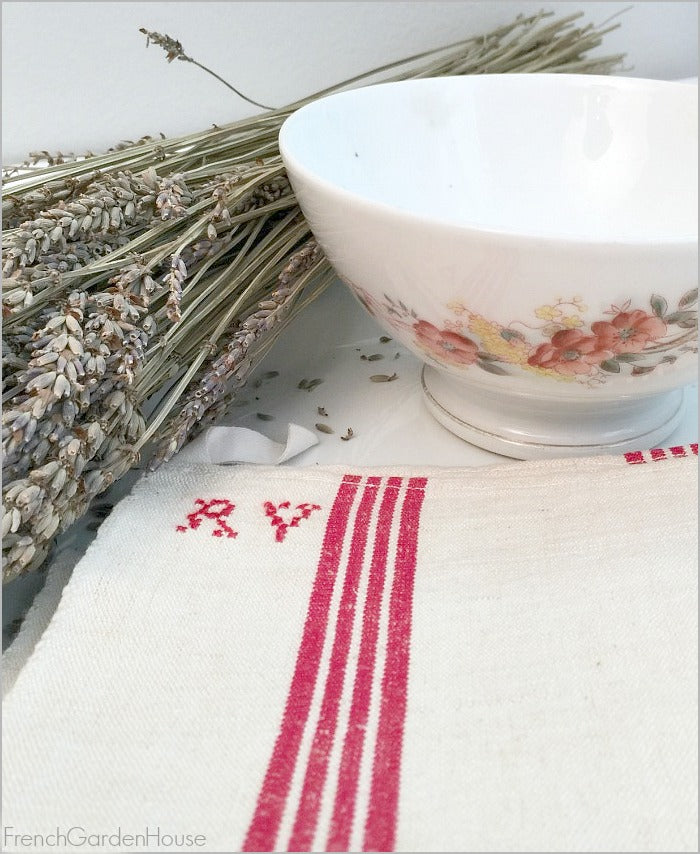
 They were part of a young bride's dowry, often made by herself and her mother and sisters, each monogram expertly stitched with such care, each selvage hemmed with the tiniest stitches. Put away in her dowry chest until her marriage day.
 I'm not sure why the ones I often find were never used, either her marriage day never came {so sad but there was WW! and WWII to contend with} or she made so many that she never used all of them! I prefer to think that's what happened, you?
 I love that you join me in your love for these old hand made linens. And that you write to me that you USE them! Which makes me, and those little linens, so happy. Because they were made to be used and enjoyed, and putting them in neat piles with a little sachet of lavender in our linen closets really doesn't do them justice.
 Their quality and the hand woven fabric is one-of-a-kind...it just isn't made any more. anywhere.
 To care for these antique and vintage Linens:
There are some wonderful soaks on the market especially formulated for cleaning antique and vintage pieces. Many can be washed in the machine, although I prefer hand washing.
The dryer is in most cases a no~no, it will remove too much "lint" and sooner or later your embroidered wonderful piece will be threadbare. Instead, hang your linens outside in the fresh air to dry.
To care for these antique and vintage Linens:
There are some wonderful soaks on the market especially formulated for cleaning antique and vintage pieces. Many can be washed in the machine, although I prefer hand washing.
The dryer is in most cases a no~no, it will remove too much "lint" and sooner or later your embroidered wonderful piece will be threadbare. Instead, hang your linens outside in the fresh air to dry.
 If there is a spot, you can try this: Pat the stain with lemon and salt, or soak the cloth for a few days in a bucket of water with mild soap. Rinse gently without wringing, pressing to expel the water. Lay the cloth over a clean white sheet on a bush or grass and let the sun naturally dry and bleach it. Repeat the process as necessary. {Grass fields in Europe used to be referred to as the bleaching fields}
We just received a gorgeous shipment of French Country Linens: SHOP THEM BY CLICKING BELOW
If there is a spot, you can try this: Pat the stain with lemon and salt, or soak the cloth for a few days in a bucket of water with mild soap. Rinse gently without wringing, pressing to expel the water. Lay the cloth over a clean white sheet on a bush or grass and let the sun naturally dry and bleach it. Repeat the process as necessary. {Grass fields in Europe used to be referred to as the bleaching fields}
We just received a gorgeous shipment of French Country Linens: SHOP THEM BY CLICKING BELOW
 I'd love to know...DO YOU USE YOUR ANTIQUE LINENS?
à bientôt
 Shop for the best in French Antiques, furniture with the patina of age, vintage accessories to delight you and your family & friends, and French Country utilitarian pieces. Treasures that make your home fresh, beautiful, inspirational and uniquely yours. Visit our shop FrenchGardenHouse.com
19 comments
I love every single one! I have 2 blue striped grainsacks that I use as pillows. I have 2 pretty little French chairs that need recovering, but I can’t think of using them for that. I just can’t imagine cutting them! I wish I had a dozen more! Thanks for another beautiful post, Lidy!
Susan, I love that you use remnants for cleaning! Me, if there is a spot or a hole, I tend to want to patch. I just recently found some antique grain sacks with the most amazing patches…and I am beyond charmed!
Chris, I know, we do need to enjoy those beautiful things…while we are able to, and to make the world a prettier more softer place for the people we love and ourselves.
Janet, thank you, that is so sweet of you to say! I think that a low tumble is just fine. It really depends on the fabric, as you know they are sturdy, it’s mainly the delicate monograms that don’t do as well being in the dryer, but anything you can do with a wool sweater or silky blouse you can certainly do with these strong old hand woven fabrics!
I love them too (actually, I’m a fabric junkie) and have most heavy pieces. I have turned some into pillow covers. Others are larger and I use as table cloths or runners. Since I live in the Chicago area, drying outside is not always an option. Do you think a low, gentle tumble in the dryer for 10 minutes til just damp is too much? Thank you so much for sharing your beautiful taste and amazing knowledge. I always learn something new from you!
Sherry, I agree! They are the perfect souvenirs to a trip to France, aren’t they? How sweet that you have those fabrics to remind you of a glorious time – a real reminder of shopping in the 9th. ?? xo Lidy
Oh Lidy there’s nothing like the red & white linens of France! I love them too and look forward to looking at your shop to see what treasures you’ve acquired. The fabrics I purchased at a little fabric shop in 9th arrondissement are so precious to me. Oh how I wish I had time to go to all of the flea markets there! Thanks for doing it for us to bring us great finds Lidy!!
Bisous, Sherry (Edie Marie)
How absolutely lovely! I understand the word swoon!! Thank you for the reminder that things of beauty are meant to be used and be a part of everyday life! Enjoy them!
Beautiful post!
There are different kinds of fabric, from cotton to linen to chanvre (hemp) to métis.
Savon de Marseille can also help get out spots if you have that. I’ve also used a paste of baking soda and hydrogen peroxide.
Drying outdoors is the only way to do them justice!
If there’s a spot that just won’t disappear, or a hole, I turn the sheet into pillowcases, cutting around the problem. And the remnants I use for cleaning. No waste.
The only thing I don’t like is ironing them. But getting into a perfectly pressed bed of antique sheets is divine.